Hello, this is Swasher Co., Ltd. 💧
Today, we have a slightly different press release to share.
It’s a video titled "Subway Air Quality Report" that aired on SBS Issue Live.
The report starts with concerns from citizens who feel uncomfortable on subway platforms, revealing the shocking reality of the air purification filters in subway stations.
Let’s take a closer look at the issue and explore possible solutions together. 🧐

😮💨 Why do we feel more suffocated on subway platforms rather than inside the trains?
Kim Tae-jin, a 79-year-old subway delivery worker, has been working underground for more than two years. From 8 AM to 6 PM every day, the subway is his workplace. Even though mask-wearing has become optional after the COVID-19 pandemic, he continues to wear a mask for nearly 10 hours a day.
When asked why, he said that the stagnant air and dust in subway stations make it difficult to breathe.
/
"It feels stuffy. You can't see it, but I’m sure a lot of dust is coming in.It definitely seems like the air quality is worse on the platform than inside the train."
Source : https://www.youtube.com/watch?v=M-ZdNvBwmSY
Many commuters have likely questioned how clean the air they breathe on the subway actually is.
Have you ever felt that the air on the platform is worse than inside the train?
🚆 Why does the air on subway platforms feel worse?
Subway platforms are enclosed spaces with poor ventilation. Whenever a train arrives or departs, it stirs up fine dust, yet the air purification system in these areas is often inadequate compared to inside the train.
Platforms are densely crowded, and the stagnant air allows more dust and harmful substances to accumulate.
Recent studies suggest that subway platform air quality may be worse than inside the train.
So, is the air purification system on subway platforms functioning properly?
🚇 Are subway platform air purification systems being properly maintained?
Let's first take a look at the subway air purification system. Since natural ventilation is difficult in underground stations, external air is drawn in through ventilation ducts and undergoes a four-stage purification process.
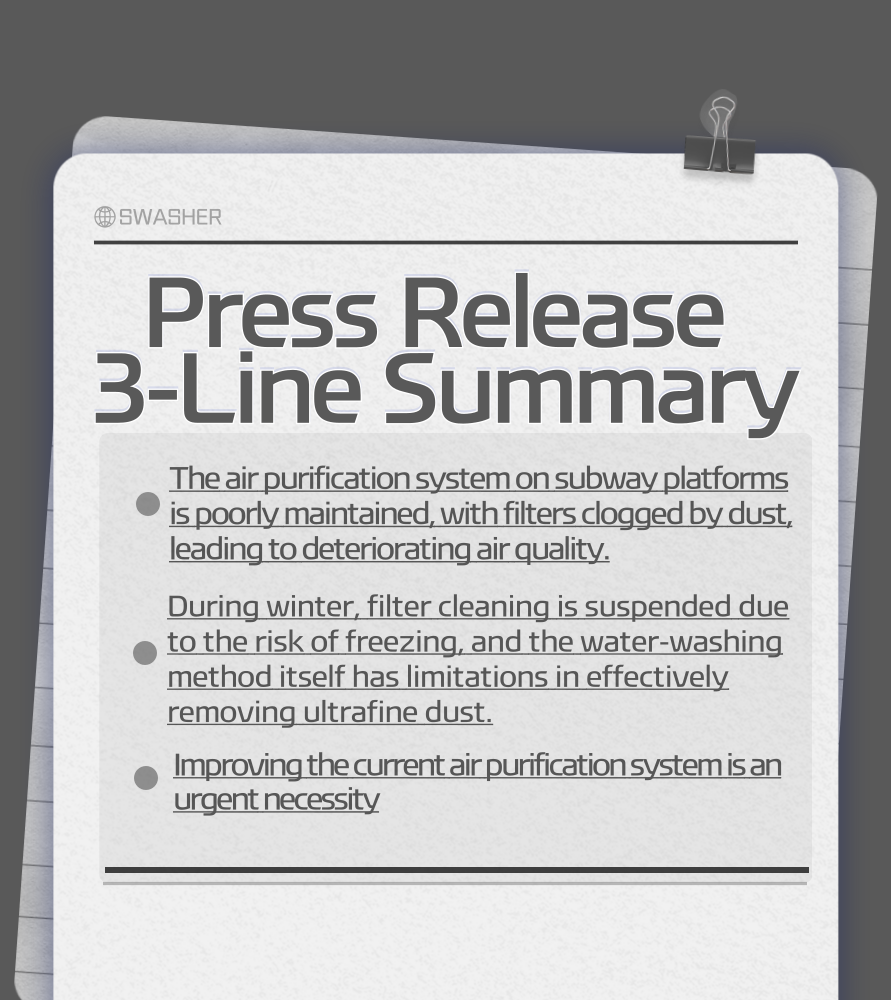
However, the problematic filters are the third and fourth-stage filters, which are the core stages of air filtration. Experts have pointed out the limitations of the water-washing method as the main reason for poor filter maintenance.
“Mold is growing inside. The air that has passed through this filter is the air that citizens are currently breathing—mold included.”
If the filters are not properly dried after washing, mold can grow. In particular, during winter, there are cases where the system is completely shut down due to the risk of freezing.
“When dust accumulates on the filters, they are cleaned with water, but there is a limit to how well water pressure can remove the dust. Winter is especially problematic because there is a lot of fine dust. Normally, the system should be operating to purify the air, but from December to March, the staff shut it down. For four months in winter, they can’t use the filters due to the risk of freezing.”
As a result, air quality in underground stations may worsen during winter, when high concentrations of fine dust are already a serious concern.
Source : https://www.youtube.com/watch?v=M-ZdNvBwmSY
🚨 1. Seasonal limitations of the water-washing method—does the system stop working in winter?
The current platform air purification system uses a water-washing method.
This method periodically washes the filters with water to remove airborne pollutants, which, in theory, helps keep the filters clean.
However, if the filters are not properly dried, a serious issue arises—the risk of mold and bacterial growth.
In particular, during winter, there is a risk of freezing, which often leads to the complete shutdown of the water-washing purification system.
In other words, filter cleaning is not performed during winter, leaving the filters neglected for extended periods.
This means that the platform air purification system is not functioning properly during winter.
Although the system is supposed to operate year-round to improve air quality,
the seasonal limitations prevent effective filter maintenance in winter,
posing a structural problem that hinders its proper operation.
🚨 2. Outsourcing maintenance—does subcontracting lead to neglect?
According to the manual, the filters should be replaced every three months, but no one knows when they were last replaced.
So, what about the weekly filter cleaning that is supposed to be performed at least once a week?
/
The filter washing system was reportedly operated last week, but no water is coming out now. KORAIL explained that this issue occurred at certain stations managed by subcontracted companies.
Source : https://www.youtube.com/watch?v=M-ZdNvBwmSY
Subway air purification systems are mostly managed by subcontracted companies (subsidiaries).
This raises several concerns:
✅ Lack of regular inspections – Filters are not cleaned or replaced on schedule.
✅ Difficulty monitoring maintenance work – No proper system to verify the subcontractor’s performance.
✅ Cost-cutting measures – Extending the filter replacement cycle to save money.
Since different stations are managed by different subcontractors, passengers have no way of knowing which stations receive proper maintenance and which don’t.
🚨 3. Structural limitations of water-washing filters—can they truly filter ultra-fine dust?
There are growing concerns that the current water-washing filter maintenance method needs improvement, as even the medium filter, which captures ultrafine dust, can become wet.
/
Most importantly, the medium filter must remain dry in order to function properly.
Source : https://www.youtube.com/watch?v=M-ZdNvBwmSY
The current system uses water-washing filters to remove airborne dust.
While effective for large particles, it has a critical flaw:
Ultra-fine dust cannot be filtered properly when the medium filter is wet.
🛑 What is a medium filter?
The medium filter is the core component of an air purification system, responsible for capturing ultra-fine dust.
Unlike regular filters, it must remain dry to function effectively.
However, since the current method involves washing filters with water, the medium filter often becomes damp, reducing its ability to filter ultra-fine particles.
❗Time for Real Change—Subway Platforms Need Better Air Purification Solutions❗
Ensuring clean air for subway passengers is a basic public safety requirement.
However, the current purification system is failing due to:
✔ Filters going unwashed during winter, worsening air quality.
✔ Poor management due to subcontracting, leading to neglected maintenance.
✔ Water-washing limitations, which fail to properly remove ultra-fine dust.
To address these issues, we need a more effective and sustainable air purification technology.
💧 Swasher Can Solve the Subway Air Quality Problem!
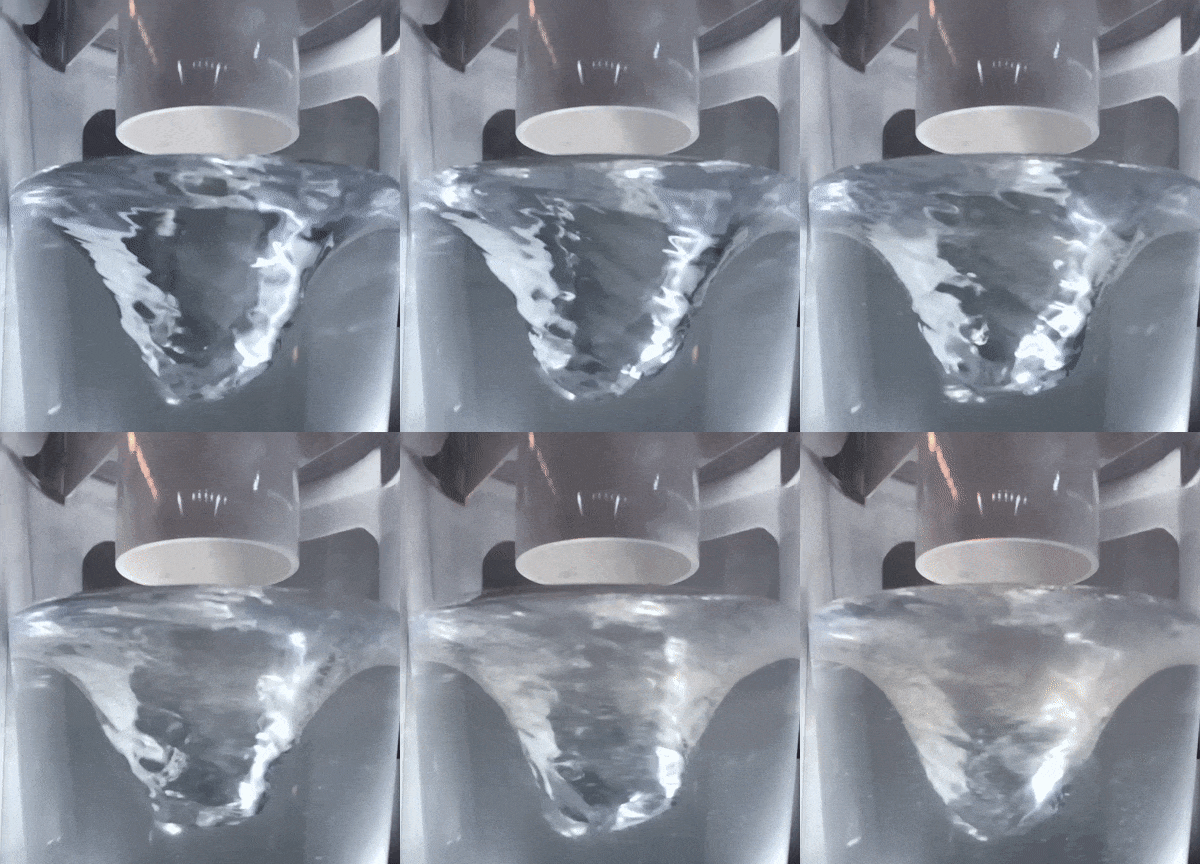
Swasher is a product that applies innovative water-based air purification technology, offering:
✅ Continuous air purification without the need for filter replacements.
✅ Advanced technology capable of effectively removing ultrafine dust, unlike conventional water-washing methods.
✅ A solution that prevents filters from getting wet, eliminating the risk of mold and bacterial growth, ensuring consistently clean air purification.
🚆 What if Swasher technology were applied to subway platforms?
✔ Overcoming the limitations of conventional water-washing methods, establishing a sustainable air purification system that requires no filter maintenance.
✔ Effectively removing ultrafine dust, significantly improving air quality on platforms.
✔ Providing clean air not only in subways but also in various public spaces, offering a comprehensive air purification solution.
The only air purifier that meets all these conditions—
Swasher!
🔍 Swasher vs. Traditional Filter-Based Air Purifiers
Comparison CriteriaTraditional Filter-Based PurifiersSwasher
| Fine Dust (PM2.5) Removal | ✅ Yes | ✅ Yes |
| Odor Removal | ❌ Limited | ✅ Highly Effective |
| Filter Maintenance Cost | Expensive (Requires Replacement) | No Filter (Only Water Replacement) |
| Bacterial Contamination | ❌ Risk of Mold & Bacteria Growth | ✅ Low Risk (Self-Cleaning with Water) |
| Eco-Friendliness | ❌ Generates Filter Waste | ✅ Sustainable, No Waste |
The only air purifier that meets all these criteria—Swasher.
🌱 Clean air should not be a luxury. Swasher ensures that it isn’t. 🌱
👉 Learn more on our official website: 🔗 www.swasher.com

📝 Conclusion
At Swasher Inc., we have always moved forward under the slogan "Air Health Care for All."
We will continue our efforts to ensure that everyone has access to clean and healthy air.
Our blog will keep providing in-depth analyses of important environmental issues, so we appreciate your continued interest and support.
Thank you for reading today!
💙Breathe fresh air with Swasher, today and always💙